
The Future of Metabolic Medicine:
Why Real-Time Cellular Control Is the Next Frontier—and What It Means for Clinical Practice Today
By: Ergo-Flex Technologies
For decades, medicine has focused on treating symptoms downstream of disease. Today, leading researchers are shifting upstream—toward real-time control of cellular metabolism itself.
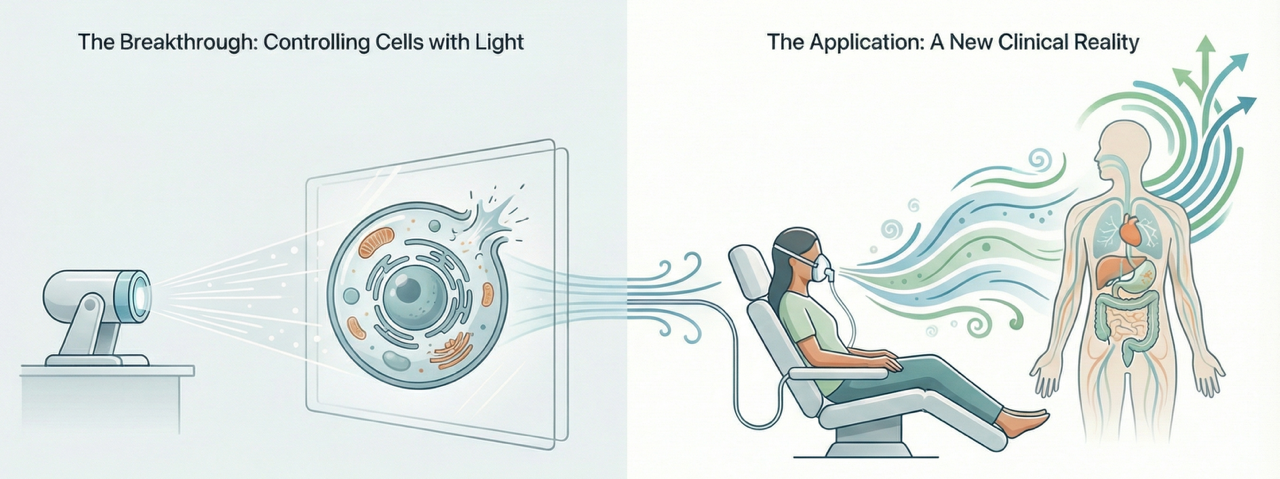
A recent study highlighted in SciTechDaily demonstrated something profound: researchers were able to precisely regulate metabolic activity at the cell membrane level using light-activated biological systems, altering cellular behavior in real time. While this research was conducted in laboratory settings using optogenetics, its implications extend far beyond the lab.
It reinforces a central truth that forward-thinking clinicians already understand:
Metabolism is not static. It is dynamic, adaptive, and controllable.
And the future of medicine belongs to technologies that can safely influence it.
What the Research Really Shows
In the study, scientists used optogenetics genetically encoded, light-responsive proteins to activate and deactivate enzymes involved in membrane lipid metabolism. By simply turning light on or off, they were able to:
• Change metabolic signaling at the cell membrane
• Alter cell movement and structure
• Reverse these changes in real time
Why does this matter?
Because it confirms that small, precise interventions at the cellular signaling level can rapidly shift metabolic behavior. The cell membrane is not just a boundary it is a control center.
This has major implications for conditions tied to metabolic dysfunction, including:
• Insulin resistance
• Neurodegeneration
• Chronic inflammation
• Age-related metabolic slowdown
The Translation Gap: From Laboratory Control to Human Care
While optogenetics is a powerful research tool, it is not a clinical solution. It requires genetic modification, specialized lab environments, and invasive methodologies that are not practical or appropriate—for patient care.
However, the principle it proves is what matters:
Metabolic processes can be intentionally modulated in real time.
The key question for clinicians becomes:
How do we apply this insight in a non-invasive, scalable, human-ready way?
Oxygen: The Most Powerful Metabolic Signal We Can Safely Control
Long before optogenetics, biology evolved around a far more fundamental signal: oxygen availability.
Oxygen is not just fuel it is information.
Changes in oxygen levels regulate:
• Mitochondrial efficiency
• Redox balance
• Cellular stress adaptation
• Gene expression related to metabolism
• Energy production and utilization
Intermittent hypoxic and hyperoxic exposure leverages this biology by intentionally cycling oxygen levels, creating controlled metabolic stress that drives adaptive improvement.
This is where new advanced equipment such as Mito2 enters the conversation.
Mito2: A Clinically Deployable Answer to a Research-Proven Need
Mito2 was designed around the same principle modern research is now validating:
Precise, repeatable metabolic signaling drives adaptation.
Rather than genetic modification or experimental light-activated proteins, Mito2 uses automated, responsive oxygen modulation to influence metabolic and mitochondrial function at the systemic level.
Key differentiators:
• Non-invasive
• No genetic manipulation
• Clinically deployable today
• Repeatable and scalable
• Designed for real-world patient populations
While optogenetics demonstrates what is possible in theory, Mito2 delivers what is possible in practice.
Why This Matters for Forward-Thinking Clinics
This convergence of research and clinical technology signals a broader shift in medicine:
• From static treatments → adaptive therapies
• From symptom management → metabolic regulation
• From organ-based thinking → cellular systems thinking
Clinics that embrace metabolic modulation now are positioning themselves at the leading edge of:
• Preventive medicine
• Longevity and performance care
• Neuro-metabolic health
• Cardiometabolic resilience
Mito2 allows clinicians to participate in this future without waiting for experimental technologies to reach patients.
The Bigger Picture: Measuring What We Modulate
As research continues to show that metabolism can be dynamically controlled, the importance of measurement and feedback becomes paramount.
Therapies that influence metabolism must be:
• Quantifiable
• Trackable
• Personalized
This is why metabolic assessment tools and outcome tracking are becoming essential companions to metabolic therapies ensuring interventions are not only innovative, but accountable.
Final Thought: From Discovery to Delivery
Optogenetics represents the frontier of discovery revealing that metabolism can be controlled with extraordinary precision at the cellular level.
Mito2 represents the next step:
delivering those principles into clinics, safely, non-invasively, and at scale.
The future of medicine will not be defined by who discovers metabolic control—but by who can responsibly apply it to improve human health.